
The Dark Side of AI: When the Fun of Being Creative with Claude and Its Friends Creates Way More Work Than You Have Time To Do
July 22, 2026 · 7 min read
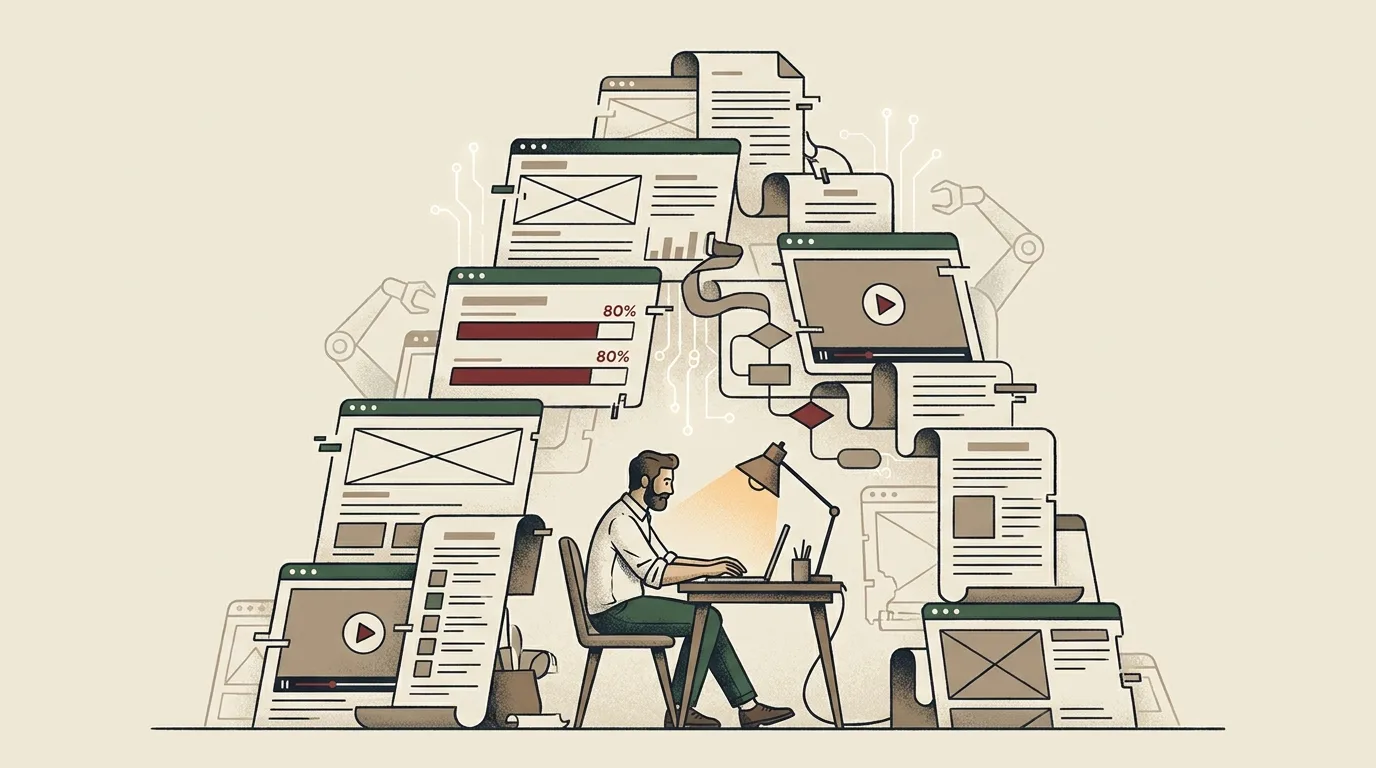
The eighty percent pile, rendered accurately. Every project back there was going to save me time.
Nobody warned me that the biggest threat to my calendar in 2026 would be my own enthusiasm.
I run a marketing agency. For years, the constraint on what we could deliver was simple and honest: hours. A client paid for a scope, the scope mapped to hours, and the hours were finite. If a clever idea showed up mid-engagement, it went on a list called "phase two," which is agency language for "probably never." That list was not a graveyard. It was a boundary. It kept the business profitable and it kept me sane.
Then the tools got good. Claude, and its friends, and the whole growing toolbox of things that can write, code, analyze, and design on command. And the boundary quietly dissolved, because the cost of starting something dropped to nearly zero.
Here is the thing no one puts in the productivity headlines: AI collapsed the cost of starting work. It did almost nothing to the cost of finishing it.
Starting is now free. Finishing still costs what it always cost. A year ago, if I had an idea for a client (a custom dashboard, a nurture sequence, a video for the homepage, a competitive teardown), the idea died a natural death at the estimate stage. Twenty hours of build time was a forcing function. I would look at the twenty hours, look at the retainer, and let it go.
Now the same idea takes forty minutes to prototype. So I prototype it. Of course I prototype it. It is genuinely fun, in a way agency work had stopped being fun somewhere around year five. And forty minutes later I am holding something eighty percent done, and that is where the trap closes. Because the last twenty percent is the same twenty percent it has always been: testing, edge cases, client review, revisions, deployment, documentation, and then the part nobody budgets, which is maintaining the thing forever. The prototype cost me forty minutes. Owning it costs me every week from now on.
I did not save twenty hours. I manufactured a new obligation that did not exist before lunch.
I am not creeping scope for my clients. I am creeping it on their behalf. This is the part I have to own. My clients are not asking for this stuff. Not one of them requested the extra automation, the additional report, the video I cropped and compressed and embedded because the homepage "needed something." I built those because I could, and because building things is the reason I got into this business before spreadsheets and status calls buried that person.
That is what makes this hard to fix. The scope creep is not coming from a demanding client I can push back on. It is coming from the most entitled stakeholder on every account: me, at 9 p.m., with a new idea and a tool that will happily say yes. AI never tells you an idea is out of scope. It just starts typing.
Every free deliverable quietly reprices your services. Here is the business problem underneath the time problem. When I hand a client something delightful they did not pay for, it does not register as a bonus for long. It registers as the new baseline. The surprise dashboard becomes the expected dashboard. The extra report becomes "the report," and someone asks why it is late. I have effectively raised my deliverables without raising my retainers, which is a strange thing to keep doing voluntarily, and I have done it with a smile because each individual instance felt like generosity instead of what it actually is: unpriced product.
Multiply that across a client roster and the math gets ugly. The agency looks busier than ever and the margin per account is quietly shrinking, not because costs went up but because the definition of "done" keeps inflating, and I am the one inflating it.
The eighty percent pile is the tell. If you want to know whether this is happening to you, do not audit your hours. Audit your unfinished things. Mine is not a list, it is a landscape: half-built automations, a report format I redesigned twice, an internal tool that works on my machine, three "quick" experiments that each spawned two more. Every one of them started as a time-saver. Together they are a second job.
The old constraint, hours, was crude but it was load-bearing. It forced prioritization at the idea stage, before any work happened. AI removed the constraint without replacing it, and it turns out that if starting is free, judgment is the only thing standing between you and infinite work in progress. I did not have to exercise judgment before. The estimate did it for me.
So here are the guardrails I am adopting. Not because the tools are bad. The tools are extraordinary, and used with discipline they really do compound an agency's output. The problem is not Claude. The problem is that I have been letting a very capable assistant take orders from the least disciplined version of me. These are the rules I am writing down, partly so my team can hold me to them:
- Every idea gets priced before it gets prototyped, even at AI speed. The question is no longer "how long will this take to build," because the answer is always "not long." The question is "what does this cost to finish, ship, explain, and maintain," and if I would not have approved that number in 2023, I do not get to approve it now just because the first draft is free.
- Prototypes get a decision within a week: kill it, or scope it. Nothing lives at eighty percent. If it is valuable, it becomes a real line item with a real owner and, where it serves a client, a real price. If it is not worth pricing, it was not worth finishing, and it gets deleted rather than parked. Parked is where obligations hide.
- Unrequested deliverables ship as proposals, not surprises. If I build something a client did not ask for and it turns out to be good, they hear about it as "here is something we could add to your engagement," not as a freebie that resets their expectations. Generosity is fine. Accidental repricing of my own services is not.
- New builds are throttled, not banned. One speculative build in flight at a time, agency-wide. When the builder itch hits and the slot is full, the idea goes on a list, and the list gets reviewed on a schedule instead of at 9 p.m. The itch, it turns out, is often gone by morning, which tells you what it was.
- The maintenance ledger is real and it gets read. Everything we have ever shipped that needs ongoing care lives in one inventory, and nothing new ships without being added to it. If the ledger is too long to read comfortably, that is not a documentation problem. That is the answer.
None of this makes me less excited about the tools. I remain the person who will cheerfully spend an evening making Claude do something nobody asked for. But I have stopped confusing that evening with productivity. Starting was never the hard part of this business, not even before AI. The hard part was always choosing, finishing, and charging correctly for the work. The tools changed everything except that.
If you run an agency and your instinct is that AI has made you faster, do the audit. Count the unfinished things. If the pile is growing, you are not saving time. You are spending it in smaller, more enjoyable denominations, and the bill still arrives.